|
|
The Three Pureness Pioneer Patriarch ( 三清 )
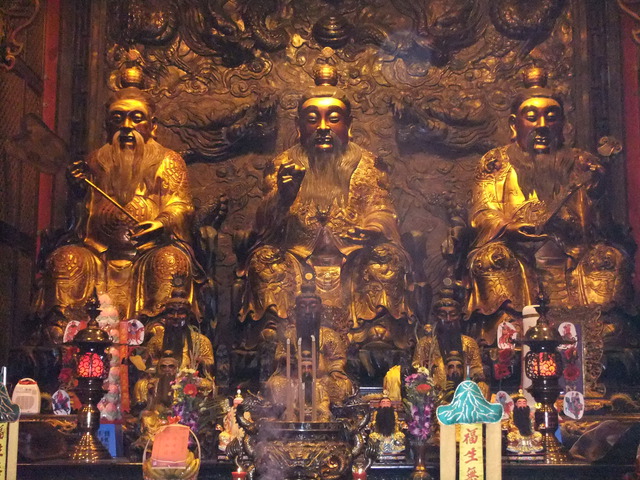
The Three Pureness is the highest Deities form in Daoism. “The Three Pureness” transcends the entire hierarchy of Daoist deities. In the middle is the ultimate highest deity of Daoism, the Primordial Divine Pioneer Patriarch, to your right is the Spiritual Treasure Heavenly Patriarch, and to your left is the Supreme Way Heavenly Patriarch.
"The Three Pureness Pioneer Patriarch" is the avatar of Daoism. AVATAR, by and large, is a word that is commonly heard but rarely understood by many. In English, the word has come to mean "an embodiment, a bodily manifestation of the Divine." The void or great emptiness in the beginning, is called "Wu Chi", or primordial chaos, at this state the Dao is a disperse form or "Chi" when reunited it is transformed into a divine being. This divine being is Tai Shang Lao Zun or Supreme Patriarch Lao Zi.
He then transforms the "One" which is Primordial Divine Pioneer Patriarch (Reverend Yuan Shi of Yu Qing). He holds a flaming divine pearl which represent the creation of the Universe, however at this stage the Universe is in a chaotic stage.
Eventually later he forms another divine being, Spiritual Treasure Heavenly Patriarch (Reverend Ling Bao of Shang Qing). At this point of time there are two forces called the "Yin" and "Yang" represented as "Tai Chi" myriads things can be formed by these forces. Therefore piritual Treasure Heavenly Patriarch or Reverend Ling Bao of Shang Qing holds a "Ru Yi", a wish fulfilling ornament.
Finally when all things are created Tai Shang Lao Zun descend and sits on the right, he holds a mystical fan, symbolizing the completion of the Universe, and the way of Dao can be spread, and living beings can seek salvation.
The Jade Emperor (玉皇大帝, Yu Huang Da Di)
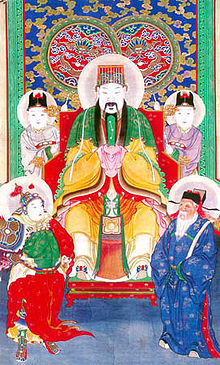
The Jade Emperor is the supreme ruler of Heavens, the hades and the protector of mankind according to Chinese folklore religion and the highest ranking deity of the Daoist pantheon.
From the ninth century onwards, he was the patron deity of the Chinese imperial family. The Jade Emperor presides over Heaven and Earth just as the earthly emperors once ruled over China.
Based on one account the Jade Emperor was originally the crown prince of the kingdom of Majestic Heavenly Lights and Ornaments. At birth he emitted a bright light that filled the entire kingdom. When he was young, he was benevolent, intelligent and wise. He devoted his entire childhood to helping the needy (the poor and suffering, the deserted and single, the hungry and disabled). Furthermore, he showed respect and benevolence to both men and creatures. After his father died, he ascended the throne. He made sure that everyone in his kingdom found peace and contentment, after that he told his ministers that he wished to cultivate Dao in a mountain cave and cultivate. After 1,750 trials, each trial lasting for 120,976 years, he attained Immortality. After another a hundred million years of cultivation, he finally became the Jade Emperor.
The Jade Emperor is usually depicted seated on a throne in imperial robes, his flat-topped crown embedded with strings of pearls that dangle from the front. He holds a short, flat tablet in clasped in both hands before his chest.
He looks very majestic with his flowing beard.
His birthday is celebrated on the ninth day of the Lunar New Year commonly known as “Tian Gong Dan” (天公誕 Festival of the Heavenly God). It is an important festival to the Daoists and Chinese community. Daoist temples throughout the world held gathering and prayers together to worship him. To beseech him to grant peace, prosperity, protection from calamities for the entire year, favorable weather conditions, and abundant harvest.
Most people are not aware that the Jade Emperor is the protector of the Buddha dharma in Buddhism. He’s called Lord Sakra or Indra or in the Shurangama Mantra (楞嚴咒) his name is recited as “Namo Yin Two La Ye” (南無因陀羅耶).
According to Buddhist text he resides in “Trayastrimsa Heaven” as in Sanksrit and means "Heaven of the Thirty-three'. The Lord of the Heaven of the Thirty-three resides above our heads. There are eight heavens in the east, eight in the west, eight in the north, and eight in the south, making thirty-two; the thirty-third is located in the center of the others and is at the peak of Mount Sumeru.
'Trayastrimsa, "Heaven of the Thirty-Three", is not thirty-third in a vertical arrangement of heavens. Vertically it occupies the second position among eighteen heavens. Its name is taken from the fact that it is the central one among a group of heavens located on the same plane, with eight heavens on each of its four sides.
The lord of the central heaven, the thirty-third, is named Sakra or Indra, and in Buddhism he is a protector of the Buddha's Dharma.
The Heaven of the Thirty-Three is eighty thousand yojanas high, and its city, the City of Good View, is made of the seven precious materials and is sixty thousand yojanas high. In the center of that city is Sakra's palace, which is made of the most exquisite and valuable gems.
In the past at the time of Kashyapa Buddha, Sakra was a very ordinary and a poor woman who saw a temple in ruins and vowed to restore it. Soliciting friends and relatives, she gradually gathered a group of thirty-two women. She herself was the thirty-third. Each of the thirty-three gave as much support as she could muster and with their collective effort they repaired the ruined temple. When each one died she ascended to the heavens and became ruler of her own heaven. The heaven in which Sakra, the former leader of the women, lives, is called the Trayastrimsa Heaven....
The Eight Immortals
The Chinese character 仙, which signify immortal, is composed of 人 man and 山 a mountain. It denotes the superior class of human spirits, who, having been deified, dwell in remote mountains devoid of human inhabitants. They are imbued with the power of being visible and invisible at pleasure, of raising the dead, of changing stones they touch into gold, and of effecting at pleasure various other wonderful transmutations. The Eight Immortals or Ba Xian (八仙), are legendary beings of the Taoist sect, said to have lived at various times and attained immortality through their cultivation of Tao’s or nature secret.
Their eminent position has been attained by cultivation, to which eight, including one female (He Xian Gu, 何仙姑) have risen higher than other.
The Chief of the Eight Immortals
Zhong LiQuan, 鐘离權
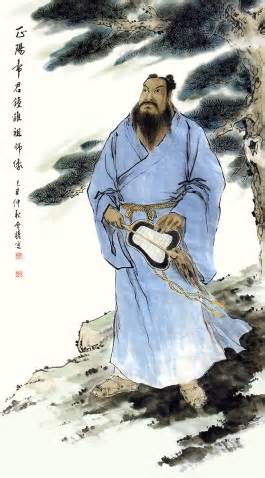
In Taoism, he is known as Zheng Yang Ju Shi, 正陽袓師. Literally, the True Yang First Master. He is the Chief of the Eight Immortals, is said to have lived during the Han dynasty and have possessed the secrets of the elixir of life, and the power of transmutation. He is also known as Zhongli of Han (漢鐘離) because he was born in the Han Dynasty. He is usually depicted as a fat man exposing his bare belly, always grasping his emblem, a fan, which has the magical ability of reviving the dead.
Zhang GuoLao, 張果老
Elder Zhang Guo, lived during the 7th and 8th century AD is a hermit who had spiritual powers of magic, i.e. rendering himself invisible, He is accompanied by a white mule, which carried him immense distances and when not, required was transformed into a paper mule, folded up and put away in his pouch. When he wished to resume his travels, he sprinkles some water upon the paper mule revived it and the mule will appear at once. He generally rode his mule backwards. His emblem is the “Yugu” (魚故), a kind of musical instrument in the shape of bamboo tube or drum with two rods to beat it.
Lu Dong Bin, 呂洞賓
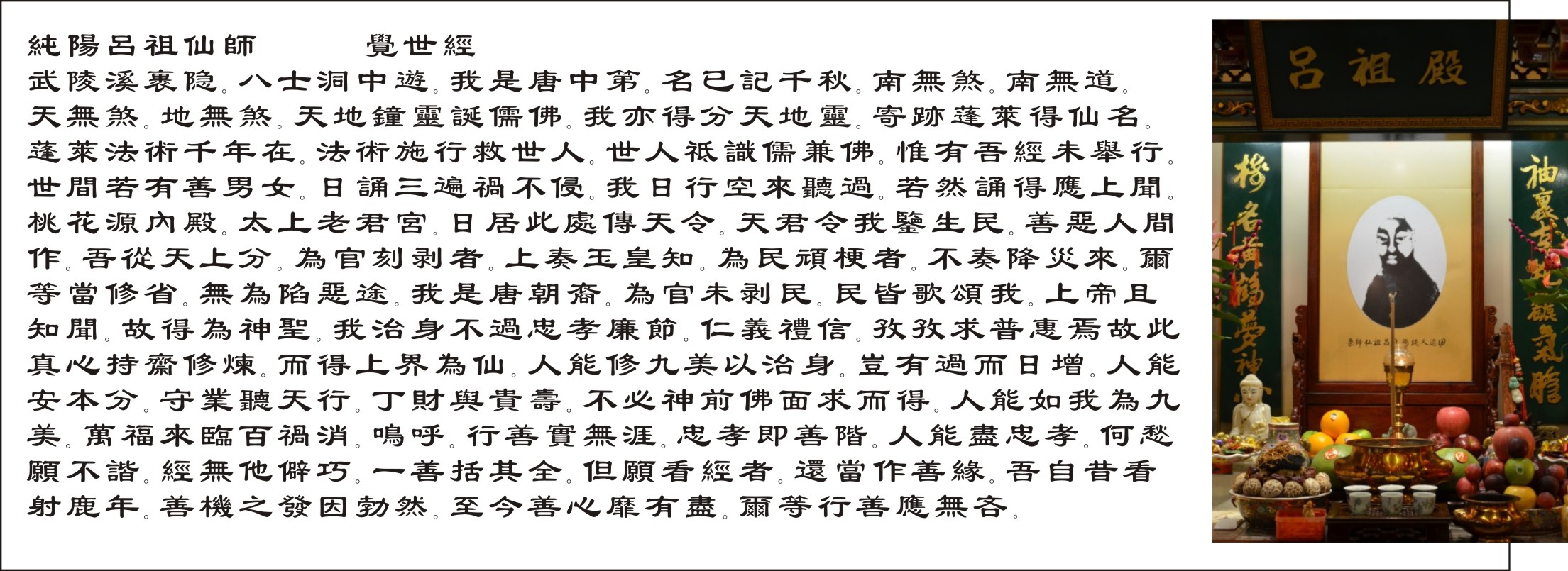
He is the most widely known among the group of deities known as the Eight Immortals and hence considered by some to be the de facto leader. He was born during the Tang Dynasty (AD750). A scholar and ascetic who learnt the secrets of Taoism from Zhong LiQuan, the Chief of the Eight Immortals, and attained immortality at the age 50. He is the patron saint of barbers and is also worshipped by the sick. He is generally depicted wearing a scholar clothes and head gear, holds in his right hand a Taoist fly whisk, and his emblem, a sword, which is slung across his back. He is well known of slaying and getting rids of various forms of evil on earth for more than 400 years.
Cao Guo Jiu, 曹國舅
He was born during the Song Dynasty (AD930-999) as the son of a military commander by the name Cao Bin 曹彬, that happens to be the brother of Empress Cao Hou 曹后. He is depicted dressed in official robes, a court headdress and he holds a pair of castanets, which is his emblem. The castanets are said to be derived from the court tablets, authorizing free access to the Imperial palace, to which he was entitled due to his birth.
Li TieGuai, 李铁拐
He was born during the Western Zhou period, and was originally named Li Yüan. He studied with Lao Tzu (founder of Taoism) and Goddess Hsi Wang Mu. He is said to have devoted 40 years to the practice of meditation and cultivation of Taoist esoteric practice.
Before becoming an immortal, he had a pleasant disposition. However, on one occasion his spirit traveled to celestial realm. He instructs his disciple to wait seven days for his spirit to return; but after six days the student had to return to attend his sick mother, so he cremated his body assuming that he had deceased.
Upon returning, Li was forced to enter the only body available, the corpse of a homeless beggar who had died of starvation; who unfortunately had "a long and pointed head, blackened face, woolly and disheveled beard and hair, huge eyes, and a lame leg." His emblem is the pilgrim’s gourd which identifies him as one of the Eight Immortals, and his iron crutch.
Han XiangZi, 韓湘子
He is the nephew of Han Yu 韓愈, a famous scholar and statesman who lived during the Tang Dynasty (AD820). He is the disciple of Lu DongBin, he became an immortal when he fell into a supernatural peach tree. He has the ability of making flowers grow and blossom instantaneously. His emblem is the flute, and he is the patron of musicians. He wanders around, playing his flute, enticing birds and beast of prey by the sweet melodious sound of his flute.
Lan Caihe, 藍采和
He was from Tang Dynasty. His behavior was out of norm and known for its bizarreness. He wore only shorts and thin shirts in winter, and thick jacket and long pants in summer. He walked with one foot bare and another with shoe.
His distinctive emblem is a flower-basket, often carried slung on a hoe over his shoulder. The basket contains various flora associated with ideas of longevity.
He Xian Gu, 何仙姑
Lived during the 7th century AD, she is the daughter of a shopkeeper of LingLing 零陵, Hunan province in the Tang Dynasty. According to one account at the age of thirteen, she often went to the mountains to collect medicinal herbs. One day, she encountered the Immortal Lu DongBin who gave her a peach and told her, “You shall become an immortal is you eat it”. She did as he said, and miraculously she, never felt hungry or thirsty, can float and jumped from one cliff to another gathering medicinal herbs to help the sick. In addition, she could predict people’s fortune. Her emblem is the lotus, which she carries in her hand. And at times she is also depicted holding a fly whisk on the other hand.
What is Dao by Wudang Dao
Daoism is the traditional religion of China. In general, it is believed that Taoist organizations were formally established 1,900 years ago by Celestial Master Zhang Daoling during the reign (AD 126-144) of Emperor Shundi of the Eastern Han Dynasty. However, the original sources of Taoist doctrines can be traced back to the Pre-Qin period (4000-221BC).
The ideological system of Taoism covers a wide range of contents. It has evolved into a religious culture based on ancient religious beliefs in China around the worship of heaven and ancestors, as well as Taoist theories and beliefs regarding immortality that arose during the Spring and Autumn, and the Warring States Periods. It has also absorbed ethical ideas from Confucianism and folk religious customs.
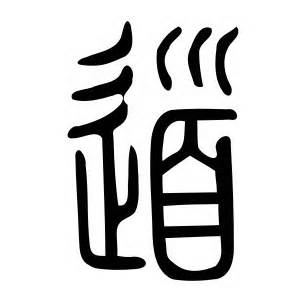
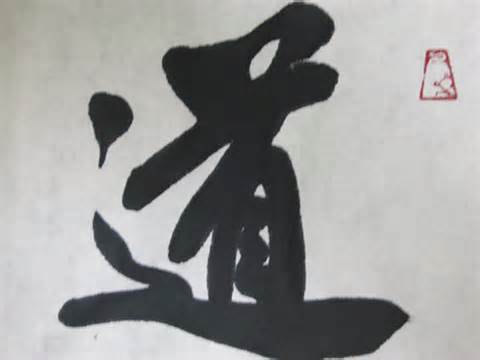
The core of Daoism is Dao (the Way), which is beyond description. It is said that Tao is the origin of the universe, the basis of all existing things, the law governing their development and change. The concept of Virtue (Te) is closely related to Tao. The Dao De Ching says, “All respect Tao yet value Virtue.”
Daoists regard Dao and Virtue as the general principles of their beliefs and behavior. They should not only cultivate Tao but also accumulate Virtue. Therefore, both Tao and Virtue serve as the basis of the Taoist doctrines. Derived from the foundation of Dao and Virtue are a whole set of principles, including non-action, non-attachment from emotions, non-struggle, and the pursuit of simplicity and truth as well as the joy of living.
Daoists believe in Tao as well as in deities and immortals. “Gods” in Taoism refer to the Celestial Worthy of Primordial Beginning, the Celestial Worthy of Numinous Treasure and the Celestial Worthy of the Way and Its Virtue, the Jade Emperor and the Great Emperor of Zhen Wu, who were born before heaven and earth separated; while “immortals” refer to humans who were born after heaven and earth separated and transformed into deities, becoming immortals through cultivating Tao. From the Taoist perspective, both gods and immortals are symbols of Tao.
There exists a hierarchy of gods and immortals in Daoism. At the top of the hierarchy are the gods of the highest ranks the Celestial Worthy of Primordial Beginning, the Celestial Worthy of Numinous Treasure and the Celestial Worthy of the Way and Its Virtue, who are the embodiment of Tao or the Tao itself. Below them are the gods of the lower ranks, who are entrusted with responsibilities according to their attainments in Tao and Virtue. The highest among them is the Jade Emperor, followed by the four major deities and other celestial beings. The Jade Emperor is the highest ruler of the universe. Different deities and immortals have different responsibilities.
The highest ideal of a Taoist is to acquire immortality. To achieve this goal, one must practice Taoism both inside and outside one's physical existence. Inner practice involves physical and breathing exercises, concentrated contemplation, and refining the internal elixir (neidan). The basic principle of this practice is still to cultivate the self both spiritually and physically. External practice involves doing good deeds and helping others. If one succeeds in both aspects, one could become immortal
Daoist doctrines are referred to as Taoist scriptures. There were different kinds of Daoist scriptures compiled at different moments in history, all under the title of the Daoist Canon (Daozang). The earliest Taoist Canon appeared during the Tang Dynasty, followed by other editions compiled during the Song, Jin, Yuan and Ming dynasties. Extant today are two editions respectively compiled during the reign of Zhengtong and the reign of Wangli of the Ming Dynasty, hence the names: Zhengtong Taoist Canon and Wanli Supplementary Taoist Canon.
The Dao De Ching by Laozi is Taoism's principal and most important canon. Other canons include Book of Secret Revelations, Book of Purity and Quietness, Book of the Lower Elixir Field, Book of Divine Deliverance and Can Tong Qi.
Many schools of Daoism were formed throughout history. During the Han Dynasty, there arose Tianshi and Taiping Daoism; during the Wei and Jin Period, there were the Shangqing, Lingbao and the Sanhuang Sects; the Song, Jin and Yuan dynasties saw different sects including Quanzhen, Taiyi, Zhenda, and Jinming. The two most prominent sects today are the Zhengyi Sect (evolved from Tianshi) and Quanzhen (founded by Wang Chongyang). Today's followers belong to either of these two sects. The Zhengyi Sect is popular mainly in Jiangxi, Jiangsu, Shanghai and Fujian provinces, while Quanzhen flourishes in other parts of China. There is no difference in basic beliefs between the two sects, with the only differences lying in their norms and regulations. Quanzhen, for example, requires its monastic followers to be vegetarian, remain celibate and live in temples, while the Zhengyi Sect has no such regulations.
Sites for Daoist activities are called Daoist temples (guan). Monastic Daoists live in temples, practicing Tao and conducting sacred rites. Ordinary believers frequent these places to burn joss sticks and worship the gods. These temples are open to visitors, too. On the birthdays of the main gods and immortals, grand services are held, attracting a steady flow of people who come to offer incense sticks and to pray for blessings. Some temples also sponsor fairs, which bring together the worshiping of gods with recreational and trading activities, to produce lively festivities.
Today, as one of the five major religions (Daoism, Buddhism, Islam, Protestantism, and Roman Catholicism) in China, Daoism has a great number of followers. There are more than 1,600 temples and more than 25,000 Taoist priests of the Quanzhen and Zhengyi Sects. The number of ordinary believers is almost impossible to assess.
Religious and philosophical Daoism
The word Daoism is used to refer to both a philosophy and a set of spiritual doctrines as well as an extensive ritual hierarchy and monastic institution. Although textbooks often distinguish between 'religious' and 'philosophical' Taoism, this is an artificial distinction, and is no more than the difference found in all religions between the practices of the faith, and the theological and philosophical ideas behind them.
Chinese and Western Daoist philosophy
A more useful distinction might be between Chinese Daoism and Westernised Daoism because some forms of Westernised Taoist philosophy add unauthentic new age and other faith elements to Taoism, while removing much of its religious content; and few Western 'Taoists' include Taoist gods and goddesses, liturgy, worship, or specifically religious meditative practices in their religious life.
Religious Daoism-BBC
Daoism in the West today is not at all like Chinese Taoist religion. Very few Westerners have adopted its gods and goddesses, although there are a few organizations... that have installed altars in their centres, worship Taoist gods, and celebrate Taoist (and Buddhist) festival days.
-Livia Kohn, Michael Lafargue, Lao-Tzu and the Tao-Te-Ching, State University of New York Press, 1998
Daoism is often taught in the West as an atheist or agnostic philosophy, but in China and Taiwan particularly, Daoism still functions like any conventional religion, and not like an abstract philosophy of life.
There are Daoist temples, monasteries and priests, rituals and ceremonies, and a host of gods and goddesses for believers to worship. These are as vital to the survival of Taoism as individual understanding and practice.
Daoism's rich palette of liturgy and ritual makes the Tao more real to human beings and provides a way in which humanity can align itself more closely to the Tao to produce better lives for all.
The religious elements of Taoism draw much of their content from other Chinese religions (including many local cults), and so enfold a very wide range of culture and belief within the wings of the Tao.
The many traditions within the Taoist framework gives priests the tools to carry out the conventional tasks of any religion: worship, healing, exorcism, intercession, purification, divination and so on.
Most Daoist temple practices are designed to regulate the relationship between humanity and the world of gods and spirits, and to organise that relationship, and the relationships in the spirit world, in harmony with the Tao.
Religious Taoism traditions
Two traditions
Religious Daoism follows two main traditions. Each has a clear hierarchical and well-organised structure with special headquarters, rules, guidelines, ordination rites and registration procedures.
The celestial masters (Tianshi or Zhengyi) - Temple Daoism are centred in Taiwan. The monastic branch of the Complete Perfection School (Quanzhen) has its headquarters in Beijing.
The Complete Perfection School ordains people and provides monastic communities as a focus for Taoist practice and rituals.
A simple, ascetic lifestyle is the norm in Daoist monasteries. They are ruled by a strict hierarchy, with the abbot at the head, the prior as the key manager of personnel (assisted by an overseer and several scribes), the provost as main administrator (assisted by a superintendent, treasurer, cellarer, as well as several vergers and cooks), and the meditation master in charge of spiritual practice (assisted by an ordination master, manager of offerings, and several overseers).
The time schedule is very rigid: a typical day begins at 3:00 A.M. and ends at 9:00 P.M. It consists of several periods of seated meditation, worship, meals, and work, including- musch as in Chan Buddhism-work in the gardens and the fields. Everybody is kept busy at all times, and all movements throughout the day are exactly prescribed and have to be executed with utmost control. Usually meditation, sleep periods, and meals are times of complete silence, and even at other times words are to be used with care and circumspection. Daoists, moreover, observe the natural cycles of the seasons and often eschew the use of artificial lights, so that their winter days are a great deal shorter than those in summer, allowing for more extensive rest in the darker phases of the year.
-Livia Kohn, Daoism and Chinese Culture
Daoist priests
Daoist priests undergo long and intense training to acquire the necessary skills. They must study music, liturgy and ritual, as well as meditation and other physical practices; and they must learn Taoist theology and the spiritual hierarchy of the Taoist deities. During this training they are required to live highly disciplined lives.
Shamanism
Taoist experts believe that they can journey in spirit to higher realms of being - in much the same way that Shamans can journey out of the body.
The Daoist traveller makes such journeys through ritual, meditation, and visualisation which separate them from this world and harmonise them with the energy flows of the universe. The journeys gradually move them closer and closer to the Tao itself.
A General Introduction to Daoism in China (www.taoist.org.cn)
Daoism is an indigenous traditional religion of China. It is generally believed that Daoist organizations were formally established 1,900 years ago by Celestial Master Zhang Daoling during the reign (AD 126-144) of Emperor Shundi of the Eastern Han Dynasty. However, the original sources of Daoist doctrines can be traced back to the Pre-Qin period(4000-221BC). Thus there is the common reference to the “Three Ancestors” that alludes to the Yellow Emperor, Lao Zi and Celestial Master Zhang.
The ideological system of Daoism covers a wide range of contents. Generally speaking, it evolved into a religious culture by basing itself on ancient religious beliefs in China around the worship of heaven and ancestors, as well as Daoist theories and beliefs regarding immortality arising during the Spring and Autumn Period and the Warring States Period. It has also absorbed ethical ideas from Confucianism and folk religious customs.
The core of Daoism is, of course, Dao ( the Way), which is beyond description. It is said that Dao is the origin of the universe, the basis of all existing things, the law governing their development and change, and the ultimate god of Daoism. The concept of Virtue (De) is closely related to Dao. Dao De Jing relates,“All respect Dao yet value Virtue.” Virtue has different connotations. One common explanation is that Virtue is the specific manifestation of Dao in specific things.
Daoists regard Dao and Virtue as the general principles of their beliefs and behavior. They should not only cultivate Dao but also accumulate Virtue. Therefore, both Dao and Virtue serve as the basis of Daoist doctrines. Derived from the foundation of Dao and Virtue are a whole set of principles, including non-action,non-passion and non-desire, non-struggle, and the pursuit of simplicity and truth.
Daoists believe in both Dao as well as in deities and immortals.“Gods”in Daoism refer to the Celestial Worthy of Primordial Beginning, the Celestial Worthy of Numinous Treasure and the Celestial Worthy of the Way and Its Virtue, the Jade Emperor and the Great Emperor of Zhenwu, who were born before heaven and earth separated; while “immortals”refer to humans who were born after heaven and earth separated and transformed into deities, becoming immortals through cultivating Dao.Among them are Celestial Master Zhang and
Lǖ Chunyang. From the Daoist perspective, both gods and immortals are symbols of Dao. There exists a hierarchy of gods and immortals in Daoism. At the top of the hierarchy are the gods of the highest ranks the Celestial Worthy of Primordial Beginning, the Celestial Worthy of Numinous Treasure and the Celestial Worthy of the Way and Its Virtue, who are the embodiment of Dao or may be said to be the Dao itself. Below them are the gods of the lower ranks, who are entrusted with responsibilities according to their attainments in Dao and Virtue. The highest among them is the Jade Emperor, followed by the four major deities and other celestial beings. The Jade Emperor is the highest ruler of the universe. Different deities and immortals have different responsibilities. Among the most popularly known are the celestial beings in charge of wind, rain, thunder, lightning, water and fire, the God of Wealth, the Kitchen God, the God of the Town and the God of the Land.
Daoism believes that the universe contains 36 heavens above and 36 hells below. The highest heaven is called Da-luo Heaven. The next three heavens are the Realm of Absolute Purity; the four heavens after that are the Four Brahmas; while the rest of the 28 heavens include the Immaterial Realm (four heavens), the Material Realm (18 heavens), and the Realm of Desire (six heavens).
Da-luo Heaven is wherein dwells the Celestial Worthy of Primordial Beginning, the Celestial Worthy of Numinous Treasure and the Celestial Worthy of the Way and Its Virtue; the Realm of Absolute Purity is the abode of nine grades of saints, realized beings and immortals. Those in the Four Brahmas are free of the pain of life and death; those in the Immaterial Realm enjoy longevity but are not free from the pain of life and death; while the people in the Realm of Desire experience all manner of desire as well as pain.
The 36 hells are the netherworld where the souls of the deceased dwell. Daoism believes that the deceased will be judged by the Ten Kings of the netherworld. A benevolent person will be reincarnated, while an evil-doer will be subject to punishment in these hells.
Daoism also believes that, among the famous mountains of the earth, there are 10 Big Daoist Caves,36 Small Daoist Caves and 72 Promised Lands, which serve as the abodes of immortals. Among the four seas, there are 10 continents and three islands, where immortals take rest and the divine grass grows. It is believed that if one eats this grass, one will become immortal. In Chinese history, the First Emperor of the Qin Dynasty and Emperor Wudi of the Han Dynasty sent people to look for these fairy islands off the sea in hopes of obtaining those elixirs.
The highest ideal of a Daoist is to acquire immortality. To achieve this goal, one must practice Daoism both inside and outside one's physical existence. Inner practice involves physical and breathing exercises,concentrated contemplation, and the taking of elixirs. Later, this type of practice gradually came down to refining the interior elixirs ( neidan ). The basic principle of this practice is still to cultivate the self both spiritually and physically. External practice involves doing good deeds and helping others so as to acquire
more merit and virtue. If one succeeds in both aspects, one could enter the world of immortals.
The books that record Daoist doctrines are referred to as the Daoist scriptures. There were different kinds of Daoist scriptures compiled at different moments in history, all under the title of the Daoist Canon .
The earliest Daoist Canon appeared during the Tang Dynasty, followed by other editions compiled during the Song, Jin, Yuan and Ming dynasties. Extant today are two editions respectively compiled during the reign of Zhengtong and the reign of Wangli of the Ming Dynasty, hence the names: Zhengtong Daoist Canon and Wanli Supplementary Daoist Canon . The decree from a Yuan-dynasty emperor to burn Daoist Canon resulted in the loss of a great number of Daoist doctrines. Today, the Daoist Association of China is making efforts to recompile an anthology of Daoist doctrines, entitled China's Daoist Canon .
The Dao De Jing by Lao Zi is Daoism's principal and most important canon. Other canons include Book of Secret Revelations , Book of Purity and Quietness , Book of the Lower Elixir Field , Book of Divine Deliverance, and Can Tong Qi .
Many schools of Daoism were formed throughout history. During the Han Dynasty, there arose Tianshi Daoism and Taiping Daoism; during the Wei and Jin Period, there were the Shangqing Sect, the Lingbao Sect, and the Sanhuang Sect; the Song, Jin and Yuan dynasties saw Quanzhen Daoism, Taiyi Daoism, Zhenda Daoism, and Jinming Daoism. Historical fusion brought many different sects together, from which two important sects, the Zhengyi Sect (evolved from Tianshi Daoism) and Quanzhen Daoism (founded by Wang Chongyang), finally developed. Today's Daoist followers belong to either of these two sects. The Zhengyi Sect is popular mainly in Jiangxi, Jiangsu, Shanghai and Fujian provinces, while Quanzhen Daoism flourishes in other parts of China. There is no difference in basic beliefs between the two sects, with the only differences lying in their norms and regulations. Quanzhen Daoism, for example, requires its followers to be vegetarians, remain single and live in temples, while the Zhengyi Sect has no such regulations at all.
Sites for Daoist activities are called Daoist Palaces ( gong ) or temples ( guan ). Daoists in the early days preferred to build their temples in wild but serene mountains and forests. With the spread of Daoism, more and more temples were built in urban areas. Each of them came to enshrine a great number of statues of deities and immortals. Daoists lived in the temples, practicing Dao and conducting sacred rites. Ordinary believers frequented these places to burn joss sticks and worship the gods. These temples were open to visitors, too. On the birthdays of the main gods and immortals, grand services were held in the temples, attracting a steady flow of people who came to offer incense sticks and to pray for blessings. Some temples also sponsored fairs, which brought together the worship of gods with recreational and trading activities, to produce lively festivities.
Daoism, during its time-honored history of development, has exerted far-reaching influences on China's philosophy, literature, arts, medicine and science. What merits special attention is its great contribution to ancient Chinese medicine and chemistry. A folk saying goes, “Nine out of 10 Daoists are doctors.” Daoists' pursuit of longevity and health resulted in many Daoists excelling in medicine. Some renowned senior Daoists, like Ge Hong of the Jin Dynasty, Dao Hongjing of the Southern and Northern Dynasties and Sun Simiao of the Tang Dynasty, were all well-known doctors and pharmacists. Daoists of early times attached great importance to minerals, mainly lead, mercury, sulfur, gold, and silver, from which they believed elixirs could be made. They had hoped that these elixirs could free them from the terrors of death.During this process they discovered certain chemical phenomena, which they recorded. Their records thus became the most valuable documents in ancient Chinese chemistry. Joseph Needham, historian of science, wrote in his Science and Civilization in China : “Many of the most attractive elements of the Chinese character derive from Daoism. China without Daoism would be a tree of which some of its deepest roots had perished.”What is worth mentioning here is that gunpowder, one of China's four great inventions, was actually invented by Daoists during their attempts to create elixirs.
Daoist culture has long permeated the everyday life of ordinary Chinese people since it exerted great influences on social customs in ancient China and on the shaping of national consciousness. The venerated Lu Xun, the great Chinese writer, once said, “China is rooted in Daoism.”Daoism has played an important role in the making of traditional Chinese culture. To know it is to possess a key to a better understanding of traditional Chinese culture.
Today, as one of the five major religions or teachings (Daoism, Buddhism, Confucianism, Islam, Protestantism or Roman Catholicism) in China, Daoism has a great number of followers. There are more than 1,600 temples and more than 25,000 Daoism priests of the Quanzhen Daoism and the Zhengyi Sect. The number of ordinary believers is almost impossible to assess.
Daoism has also found its way to other parts of the world. Daoist methods of keeping fit and healthy, as well as the Daoist concept of harmonious coexistence between humans and nature, have claimed a great deal of attention. Daoism is attracting the interest of an increasing number of people worldwide.
The emblem of Daoism is the Taiji symbol, or diagram of the cosmological scheme, comprised of a circle with an S-shaped line dividing the white ( yang ) and black ( yin ) halves.
[ 本帖最後由 宏泓道者 於 2013-7-23 01:11 PM 編輯 ] |
|


 IP卡
IP卡 狗仔卡
狗仔卡 發表於 2013-7-23 09:56:38

 提升卡
提升卡 置顶卡
置顶卡 沉默卡
沉默卡 喧嚣卡
喧嚣卡 变色卡
变色卡 显身卡
显身卡