|
|
| |
據BBC五月十九日報導,考古學家在尼加拉瓜的大西洋沿岸地區發現了瑪雅文明的遠古遺址。新遺跡的發現擴大了瑪雅文明所包含的範圍。 研究人員在庫克格拉希爾(Kukra Hill)鎮附近的遺址(El Cascal de Flor de Pino)工作了六年,發現了一個大約2700年前的古文化遺址,包括一個城鎮和多個村莊,有紀念碑和岩石雕刻,以及一個最顯著的、有很多可能用來作墓葬或祭祀用的巨大石柱中心。研究人員認為人們在這個遺址生活了一千年。 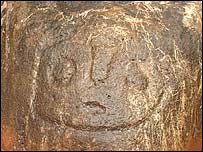
岩石雕刻西班牙考古學家Ermengol Gassiot認為,出土的陶器和在伯利茲(Belize)發現的“前古典時期”(pre-classical )的文物相似,這裏發現的圓柱與在墨西哥遺址發現的、作為祭祀用途的圓柱相同。 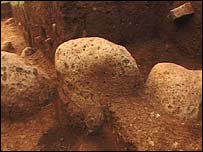
製造祭祀用的巨大石柱中心新發現的文明遺址與北部瑪雅文明相似。專家指出,庫克格拉希爾遺址的發現,表明瑪雅文化所覆蓋的範圍比考古學家原先認為的範圍 (包括瓜地馬拉、墨西哥、洪都拉斯等)要更大一些。 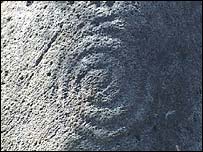
“前古典時期”的新線索這個古遺跡為甚麼消失了呢?考古學家們還無法解釋。從已發現的證據看,很多史前人類文明曾因各種災變而毀滅,這包括地震、洪水、火山、外來星體(包括隕石,彗星)撞擊、大陸板塊的升降、氣候突變等等,這些天災也都是在人類道德不行了時發生的。有科學家曾推測,長時間的氣候乾旱是導致文明達到鼎盛時期的瑪雅文明在公元前9世紀左右消失的主要原因。 瑪雅人是曾經居住在中南美洲熱帶雨林中的一個具有高度科學文明,具有非常豐富的天文知識、有著許多有關人類、生命和宇宙之謎的答案,也留下了巨大金字塔、神殿和一些古建築。然而就是這樣一個高度文明的民族也從地球上消失了。
Ancient Nicaraguan society found
Monday, 19 May, 2003, 09:28 GMT 10:28 UK
By Richard Black
BBC science correspondent
Archaeologists have discovered what they describe as a previously unknown ancient civilisation in Central America.

A picture has emerged after several years' research
The site, near the Atlantic coast of Nicaragua, dates from before the Mayan era, and relics include what appears to be a centre for mass production of ceremonial columns.
Researchers have been working on the site at El Cascal de Flor de Pino, near the town of Kukra Hill for six years.
They've found evidence of an ancient town and several outlying villages, which developed around 2,700 years ago and lasted for a thousand years.
There are monuments, petroglyphs (rock carvings) and pottery, and most remarkably, an area where many huge columns were formed out of rock - columns which may have been used at burial sites.
Extends range

Petroglyphs are abundant
"The pottery is similar to pre-classical pottery found at sites of similar age in Belize," Dr Ermengol Gassiot, of the Universitat Autonoma de Barcelona, Spain, told BBC News Online.
"And the columns resemble those found at Mexican sites where they had ritual uses.
"The society had political centres. Kukra Hill, we believe, was a small town, and at least three villages lay around it and were dependent on it."
The newly discovered civilisation is similar to the societies that preceded the Mayan civilisation further to the north.

A centre for mass production of ceremonial columns
Independent experts say this shows that the process that led to the founding of the Mayan cities, such as Tikal, Palenque, or Copan (in Guatemala, Mexico, and Honduras respectively) covered a much larger geographical region than archaeologists have supposed up to now.
Time before
Much research remains to be done at El Cascal de Flor de Pino but it promises to reveal a vast amount about the various societies and customs which were eventually assimilated into the great culture of the Mayas.
Commenting on the discovery, Jeremy Sabloff, Williams Director of the University of Pennsylvania Museum of Archaeology and Anthropology, US, said: "This site sounds very exciting and full of potential.

New information about pre-classical times
"We're learning lots now about the pre-classical era - the groups which came before the Maya - and this discovery greatly extends the range of these pre-classical civilisations."
In addition to researchers from the Universitat Autònoma de Barcelona (UAB), the Kukra Hill archaeological team includes members from the Universidad Nacional Autónoma de Nicaragua (UNAN-Managua), and the Consejo Superior de Investigaciones Científicas (CSIC).
http://news.bbc.co.uk/2/hi/science/nature/3035113.stm
| | |
|
|
|
|


 IP卡
IP卡 狗仔卡
狗仔卡 發表於 2006-12-23 21:43:17

 提升卡
提升卡 置顶卡
置顶卡 沉默卡
沉默卡 喧嚣卡
喧嚣卡 变色卡
变色卡 显身卡
显身卡